
Why Tactical Digital Marketing Stops Working at Scale
Mar 4, 2026
5 mins


%201.svg)


For years, companies treated digital marketing as a function.
A team.
A monthly task.
A budget line that could expand or shrink with priorities.
Something that could be paused, outsourced, or revisited later.
But quietly—without announcement—digital marketing evolved into something far more fundamental.
It became digital infrastructure.
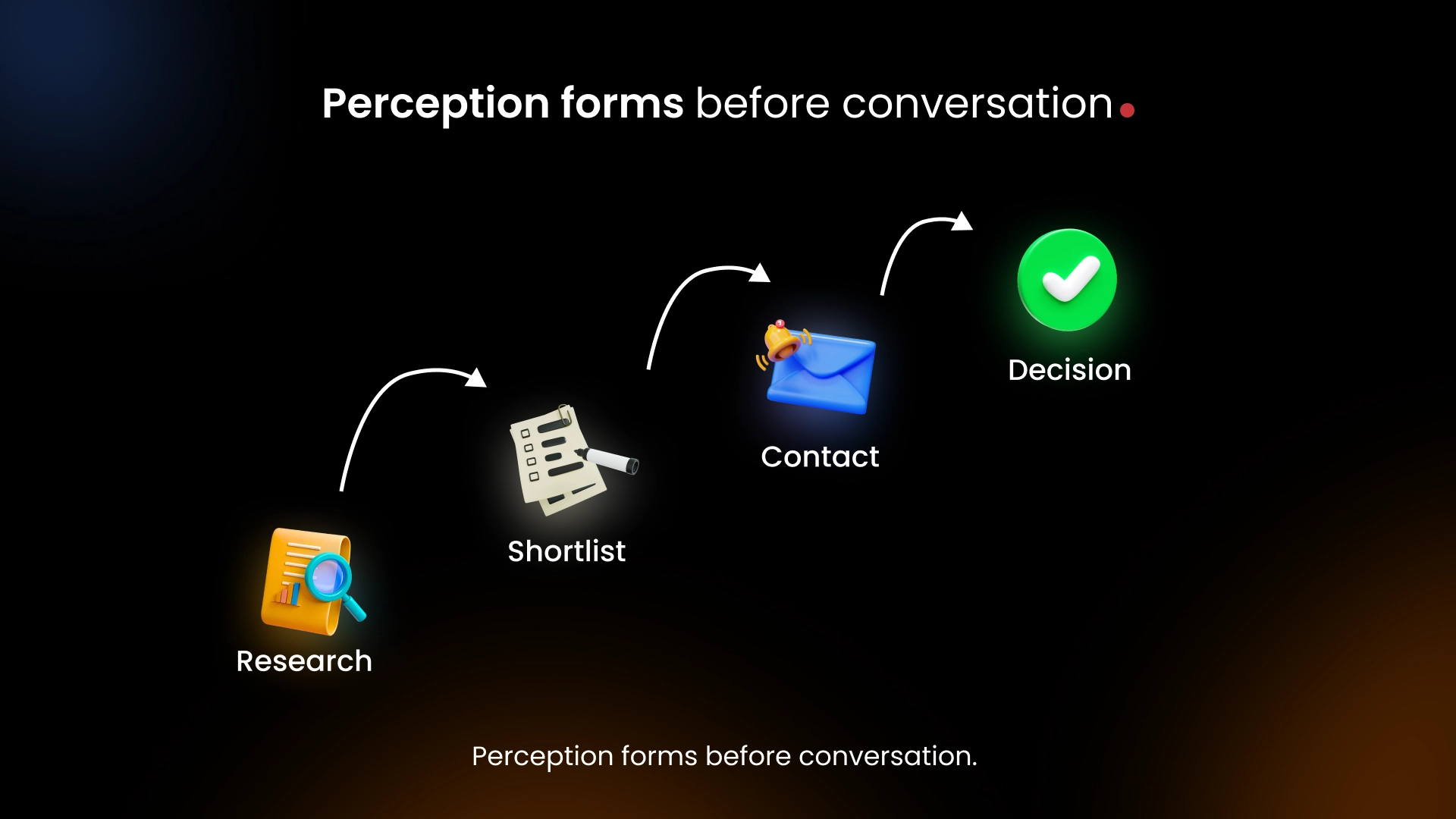
Today, a company’s visibility, credibility, and sales readiness are shaped long before a conversation with sales ever begins.
Prospects now:
In many cases, the decision journey is already underway before the first human interaction.
That is no longer a marketing influence.
That is operational reality.
And operational realities are infrastructure.
Across logistics, manufacturing, SaaS, and professional services,
buyers no longer begin with outreach.
They begin with independent research.
Search engines, AI assistants, LinkedIn signals, directories, and peer validation now shape perception before contact.
This shift creates a new truth:
Sales readiness now starts outside the organisation.
If your business is not discoverable, credible, and clear during this research phase,
you are not losing on price or capability.
You are simply not entering the consideration set.
And the most expensive losses in business are the ones you never see.
Calling digital marketing “important” is easy.
Calling it digital infrastructure requires precision.
Infrastructure is something a company runs on continuously, not something it uses occasionally.
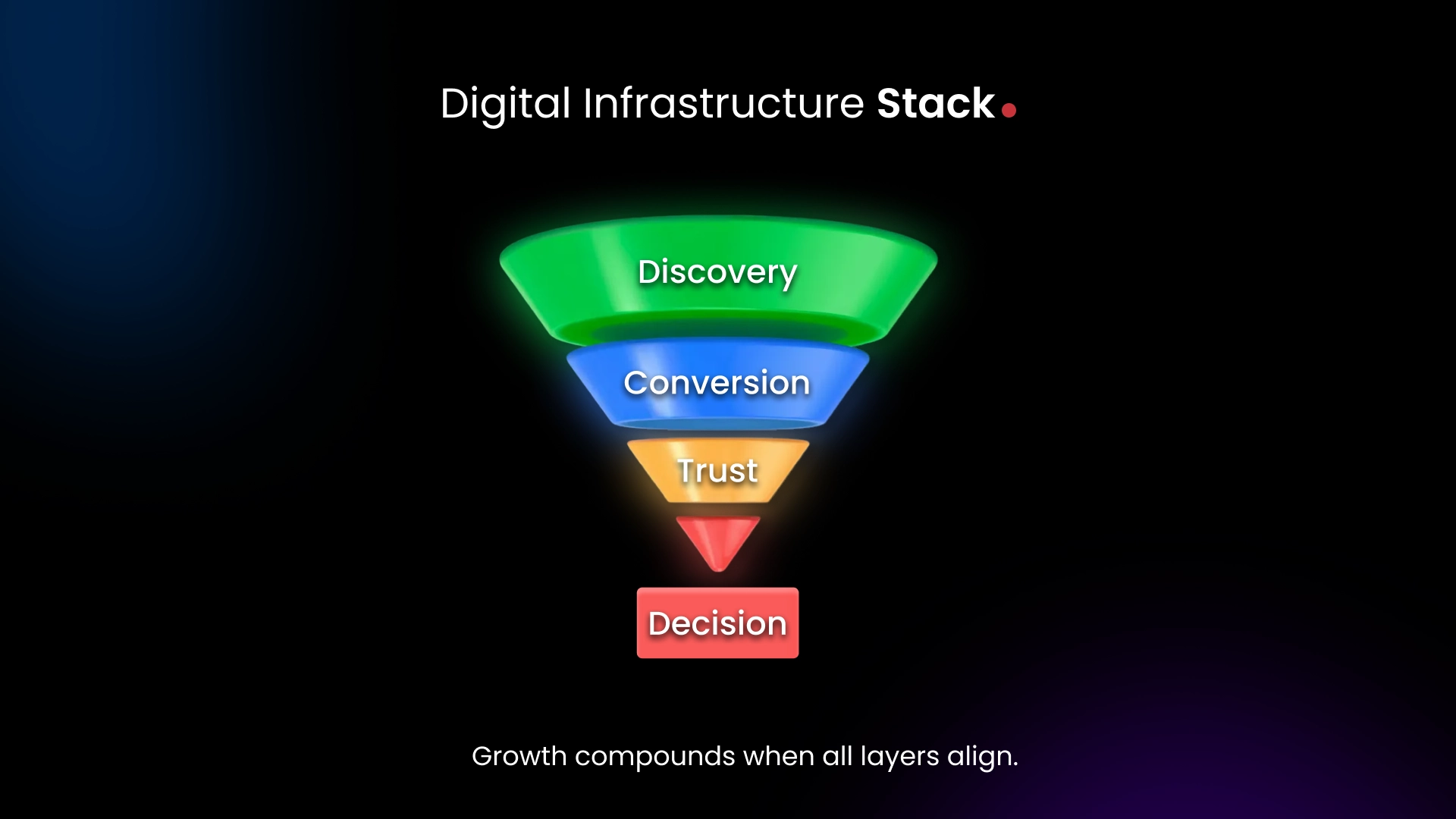
From that perspective, digital infrastructure has four structural layers:
Determines whether your company appears at the exact moment of demand.
Without discovery, growth cannot begin.
A modern business website functions as:
Discovery creates attention.
Conversion infrastructure turns attention into opportunity.
Buyers trust clarity and evidence, not claims.
Thoughtful content, consistent messaging, and industry authority reduce hesitation
and shorten sales cycles.
Sustainable growth is not guesswork.
It is measured, interpreted, and improved.
Analytics transform marketing from activity into predictable business engineering.
Together, these layers form a company’s digital operating system for growth.
Most businesses do not ignore digital marketing.
They simply contain it.
It exists as:
Activity appears present.
But structurally, nothing evolves.
The consequences are rarely immediate.
Instead, they unfold gradually:
Revenue may still arrive.
Referrals may still close.
Operations may still continue.
Which is precisely why the structural risk remains hidden.
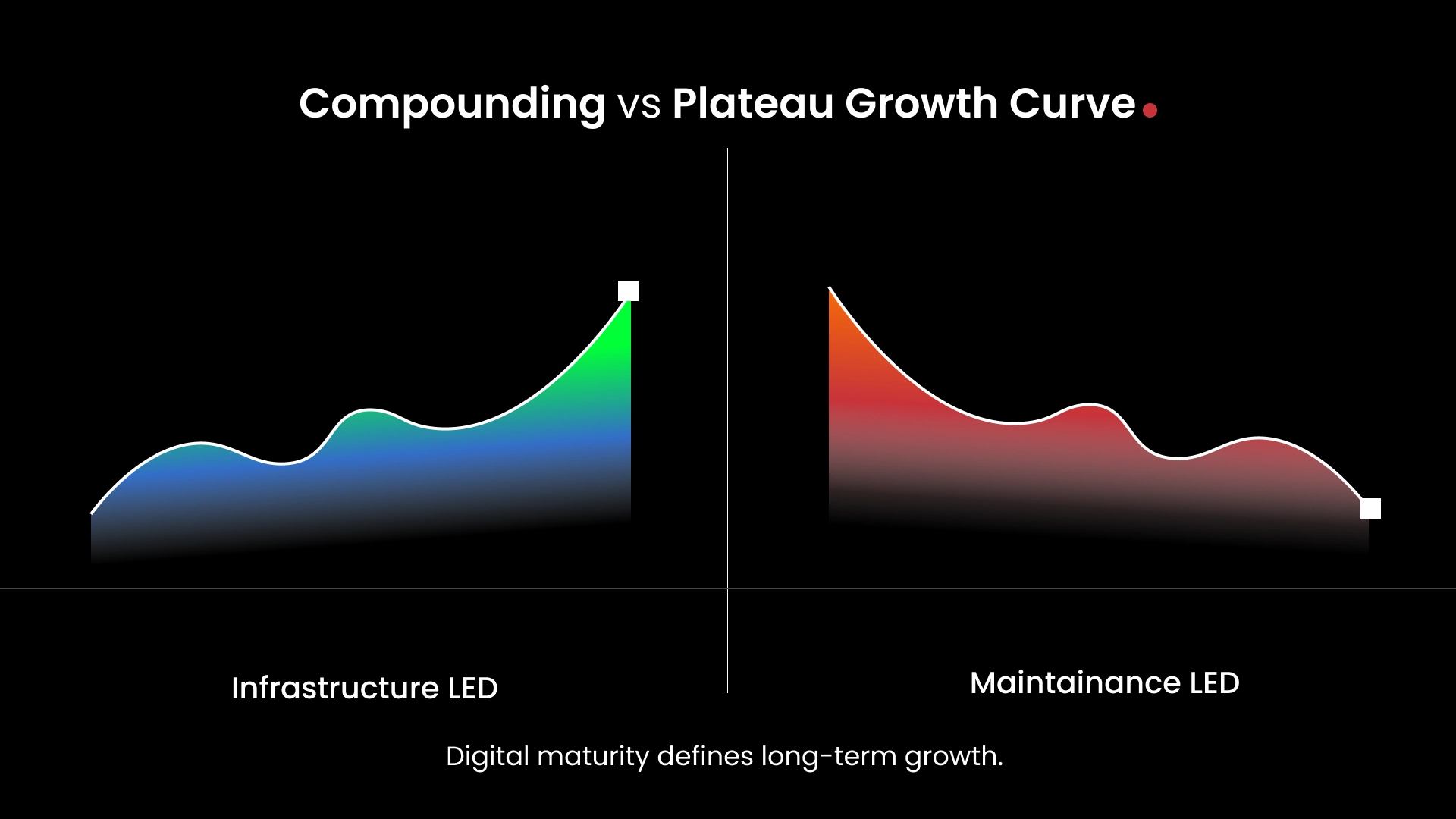
Over time, however, the gap between infrastructure-led companies
and maintenance-led companies becomes impossible to ignore.
One compounds.
The other plateaus.
Organizations that treat digital marketing as marketing infrastructure behave differently in subtle—but decisive—ways.
They do not chase every platform.
They build systems that endure.
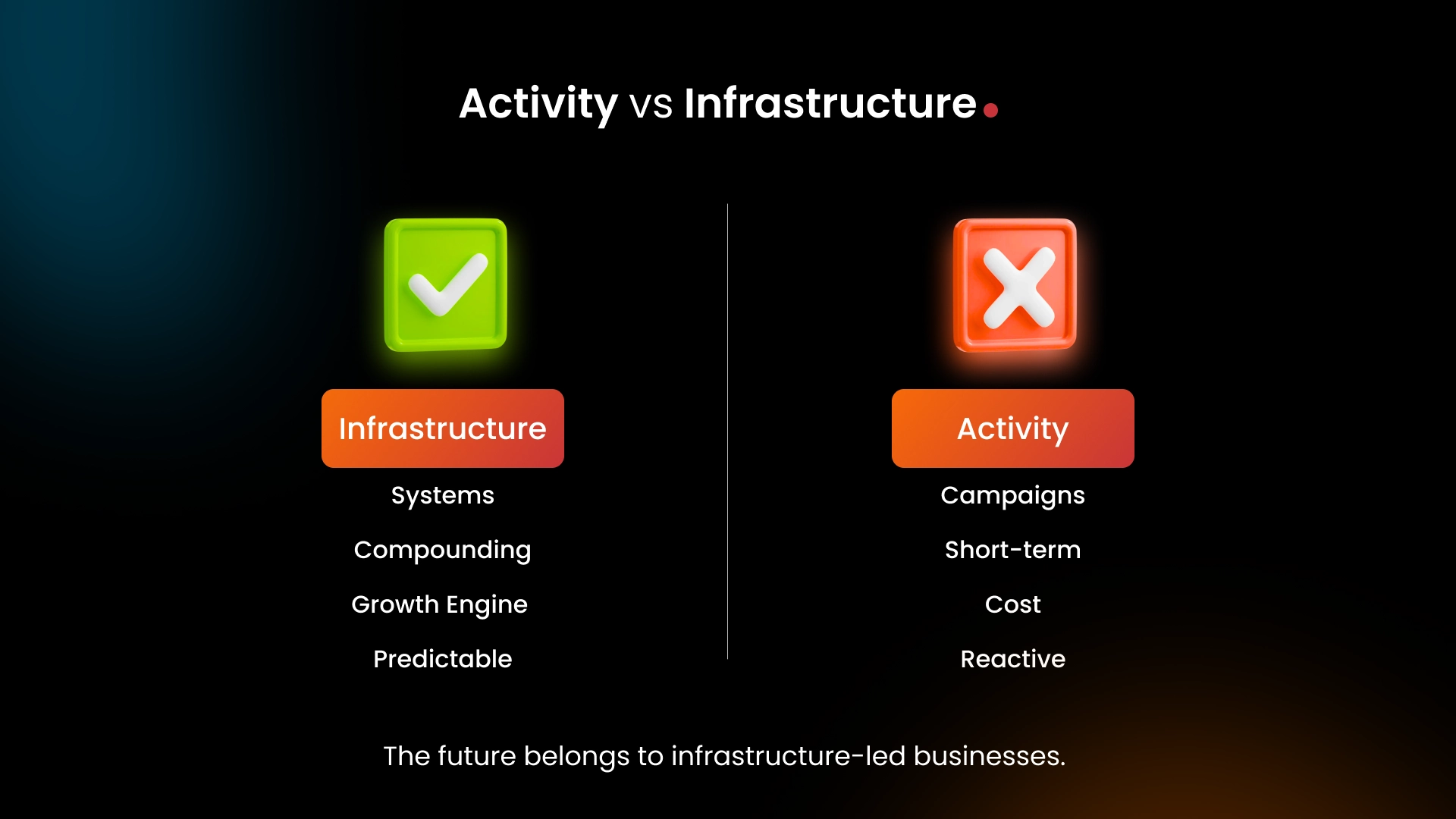
SEO becomes visibility infrastructure, not a short campaign.
User experience, clarity, and structure are designed to accelerate trust and decisions,
not just display information.
Content is created to educate, reassure, and differentiate,
not simply to publish.
Analytics connect effort to outcomes,
turning marketing infrastructure into a strategic growth engine.
Individually, these actions seem incremental.
Collectively, they redefine how businesses scale.
Three forces are accelerating the importance of digital infrastructure:
Search now includes AI summaries, recommendations, and contextual answers.
Only clear, authoritative digital ecosystems surface consistently.
In logistics, manufacturing, and enterprise services,
buyers equate digital maturity with operational maturity.
Trust begins online.
When competitors invest in SEO, UX, and authority infrastructure,
their advantage grows quietly every month.
Catching up later is always more expensive than building early.
At a certain stage, the conversation shifts away from tools and tactics
toward architecture and systems.
Because infrastructure is never assembled randomly.
It is engineered intentionally.
This is where experienced strategic partners become essential—
not to run campaigns,
but to help businesses design, build, and scale digital infrastructure that compounds over time.
At Parashift Technologies, this philosophy is not theoretical.
It is operational.
We work with logistics companies, growing enterprises, and ambitious SMEs
to transform fragmented digital activity into structured marketing infrastructure—
aligning discovery, conversion, trust, and analytics into a single growth system.
Not louder marketing.
Stronger foundations.
Ignoring digital infrastructure rarely causes sudden failure.
Instead, it creates:
The business continues.
But its potential quietly narrows.
And by the time the limitation becomes visible,
recovery demands far more effort than early investment ever would.
Digital marketing has outgrown its old definition.
It is no longer a promotional layer beside operations.
It is part of the operational core itself—a company’s marketing infrastructure.
The organizations that recognize this early build:
Those that delay rarely collapse overnight.
They simply grow slower than they could have.
At Parashift, this belief shapes how we build, design, and scale digital ecosystems for modern businesses.
Because digital infrastructure is not a philosophy.
It is the foundation of durable growth in 2026 and beyond.